Why Home Service Companies Miss So Many Calls (And How AI Can Actually Help)
Jan 8, 2026
Missed calls cost service companies real jobs. Learn why calls go unanswered, where traditional phone systems break down, and how businesses fix the issue without burning out their teams.

You can’t be in two places at once. You can’t be under a kitchen sink and on a sales call at the same time. You can’t staff your office for a 300% spike in calls that only lasts a few days. And you can’t expect your team to be available 24/7 without burning them out.
These are the hard realities of running a home service business, and they directly lead to missed calls.
Missed calls end up being the result of phone systems that do not scale with how your business operates.
AI isn’t a magic pill that will change that reality; however, AI does have the ability to act as a force multiplier for your existing team.
Before we get into how AI can improve your lead capture and operational efficiency, here are 7 reasons why home service companies continue to miss calls despite their best efforts.
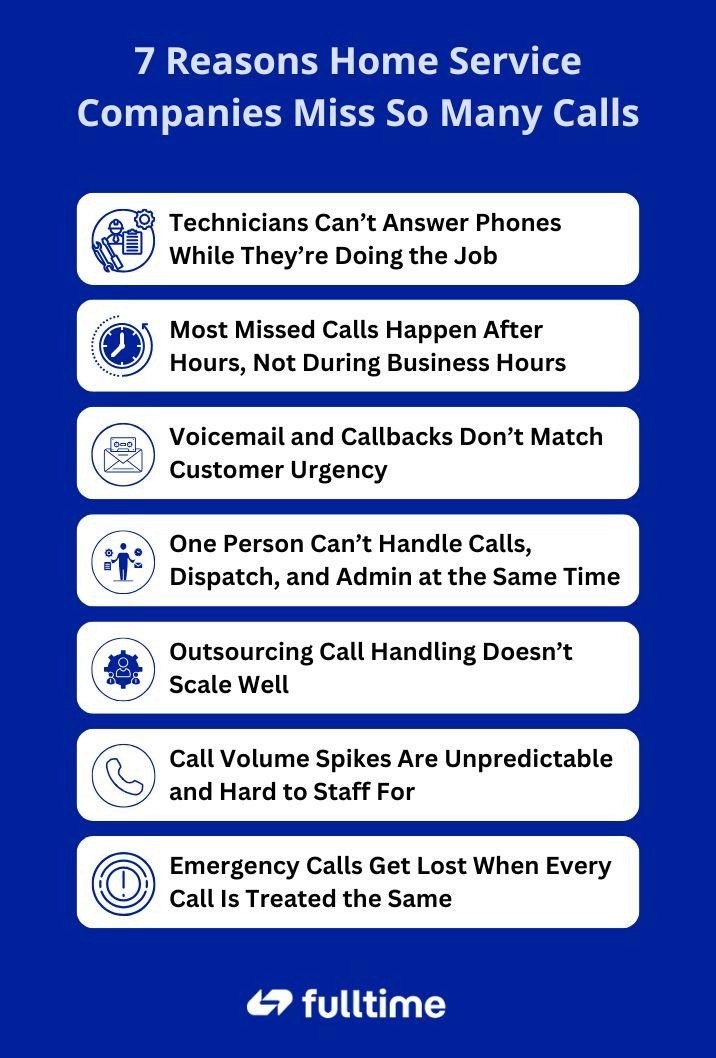
7 Reasons Home Service Companies Miss So Many Calls
1. Technicians Can’t Answer Phones While They’re Doing the Job
Most home service businesses are built around technicians being in the field and not behind a desk.
When a tech is diagnosing an HVAC issue, working under a sink, or on a ladder, answering the phone simply isn’t an option. Even hands-free calls can be unsafe or impractical during active work.
This creates a natural bottleneck.
Calls tend to come in while technicians are already busy, and if there isn’t dedicated phone coverage in place, those calls go unanswered.
Over time, this becomes a structural problem, and as teams grow, the gap between incoming calls and available people to answer them only widens.
2. Most Missed Calls Happen After Hours, Not During Business Hours
Many home service calls come in outside of standard business hours. Evenings, weekends, and holidays are often when problems surface, especially for heating, cooling, plumbing, and electrical issues.
Unfortunately, these are also the times when offices are closed or running with minimal coverage.
Some businesses rely on voicemail or on-call staff after hours, but response times are inconsistent. A missed call at 9 p.m. or on a Sunday afternoon often means the customer moves on to the next company rather than waiting for a callback the following day.
This creates a quiet but significant gap in coverage.
The business may appear fully staffed during the day, yet still lose high-intent leads simply because no one is available when a customer calls.
3. Voicemail and Callbacks Don’t Match Customer Urgency
Voicemail is often treated as a fallback, but it doesn’t align with how customers behave when something goes wrong in their home.
A Salesforce study found that 77% of customers expect to interact with a business immediately after making contact.
That expectation makes sense.
When a pipe bursts or the air conditioning stops working, callers are looking for immediate reassurance that help is on the way.
Leaving a message and waiting for a callback doesn’t provide that certainty.
In many cases, callers do not leave a voicemail at all. As mentioned earlier, they hang up and call the next company on the list. Even when a voicemail is left, callbacks often happen after the customer has already booked service elsewhere.
The issue with voicemail is that the delay creates friction at the exact moment customers need clarity.
4. One Person Can’t Handle Calls, Dispatch, and Admin at the Same Time
In many home service businesses, the same person is responsible for answering phones, scheduling jobs, dispatching technicians, and handling administrative tasks.
When everything is quiet, this setup can work. When calls start coming in back-to-back, something has to give.
Answering a phone pulls attention away from dispatch. Dispatch pulls attention away from scheduling. Scheduling pulls attention away from billing, follow-ups, or customer updates.
In this case missed calls happen because the person responsible is already handling something equally urgent.
This kind of multitasking creates constant interruptions and increases the chance that calls go unanswered during busy periods, even when someone is technically “on duty.”
5. Hiring or Outsourcing Call Handling Doesn’t Scale Well
Hiring additional staff or outsourcing calls to a call center is often the first solution businesses try.
While this can help in the short term, it introduces new challenges. Staffing costs increase, training takes time, and turnover can be high.
Call centers, scripts, and a lack of context can lead to poor customer experiences.
Neither option scales cleanly with demand.
Adding staff to cover peak periods often means paying for coverage during slow times.
Outsourced services may handle volume, but they rarely understand a company’s services, service areas, or urgency rules as well as an internal team.
As a result, missed calls may decrease temporarily, but inefficiencies and costs rise, and the underlying scalability problem remains.
6. Call Volume Spikes Are Unpredictable and Hard to Staff For
Home service call volume rarely follows a predictable pattern. A sudden heatwave, cold snap, storm, or power outage can trigger a surge of calls within hours.
On normal days, call volume may be manageable, but on peak days, it can overwhelm even well-staffed offices.
The challenge is that these spikes are difficult to plan around.
Staffing for peak demand means paying for idle time during slower periods, while staffing for average demand almost guarantees missed calls when things get busy. Many businesses are forced to choose between overstaffing and accepting that some calls will be missed.
This unpredictability is one of the main reasons missed calls persist, even in companies that take customer service seriously.
7. Emergency Calls Get Lost When Every Call Is Treated the Same
Not all calls are of the same urgency, but many phone systems treat them as if they were.
A routine maintenance inquiry and a no-heat emergency often end up in the same queue, delaying callers who need immediate help.
When call volume is high, it’s natural for emergencies to get buried.
Without a way to quickly identify and prioritize emergencies, staff are forced to work through calls in the order they arrive. This increases frustration for customers and puts additional pressure on teams trying to triage issues manually.
The result is that high-intent, time-sensitive calls are more likely to be missed or mishandled, even though they represent some of the most valuable jobs.
How AI Answering Services Solve the Missed Call Problem
At the crux of it, most missed calls in home service businesses fall into a few buckets.
Calls come in when no one is available to answer them. Volume spikes faster than staffing can adjust. And urgent calls compete with routine requests for attention.
AI answering services are not designed to replace your staff or change how your business operates.
AI answering services are designed to support your existing team and systems, fill in coverage gaps, and handle calls more efficiently, especially when demand is high or availability is limited.
The first and most immediate change is simple: calls stop going unanswered.
1. Calls Are Answered Immediately, Even When Staff Are Busy or Unavailable
AI answering services answer every call the moment it comes in, regardless of who is working or what they are doing.
Instead of routing calls to voicemail or relying on someone to be free, AI provides consistent, always-on coverage. Calls are handled the same way during evenings, weekends, and peak periods as they are during regular business hours.
This shifts call handling from a staffing constraint to a system capability. Availability is no longer tied to schedules, headcount, or workload, which eliminates one of the most common causes of missed calls without changing how teams operate day to day.
2. Routine Calls Are Handled Without Interrupting Technicians or Office Staff
Not every incoming call is urgent or complex. Many callers are looking for basic information: service availability, coverage areas, pricing ranges, or what the next step looks like.
Even during busy periods, these calls still demand attention. However, they don’t require immediate human involvement.
Customer expectations have also shifted in this area. Another study from Salesforce shows that 66% of Millennials and 61% of Gen Zers prefer to use self-service systems for system requests, as long as they receive an immediate response.
AI answering services can walk callers through standard questions, gather basic job details, and set clear expectations without pulling technicians or office staff away from higher-value work.
This reduces interruptions, keeps internal teams focused, and prevents routine calls from competing with urgent issues for attention.
3. Call Volume Spikes Don’t Overwhelm the Business
AI systems can absorb seasonal spikes without creating queues or dropped calls.
AI answering services can scale and answer calls immediately, regardless of how many calls are coming in at the same time.
This prevents peak moments from turning into missed opportunities.
By removing call handling from fixed staffing limits, businesses no longer have to choose between overstaffing for rare peak days or accepting that calls will be missed when demand rises. The system scales automatically, allowing teams to respond to increased demand without disruption.
4. Emergency Calls Are Identified and Prioritized in Real Time
AI answering services can identify urgency during the call itself.
Callers are asked targeted questions that determine whether the situation is time-sensitive, safety-related, or routine.
Based on predefined rules, emergency calls can be flagged, escalated, or routed differently from non-urgent requests.
This removes the need for staff to manually triage calls under pressure.
Urgent jobs receive immediate attention, while routine requests are captured and handled appropriately, reducing both missed emergencies and internal strain during high-volume periods.
5. Every Call Becomes A Tracked Opportunity
AI answering services capture every interaction.
Even when a job isn’t booked immediately, key details are recorded just because the initial call is answered. This creates visibility into demand that would otherwise be invisible.
This allows teams to follow up intentionally rather than guess which calls matter.
Over time, this changes how missed calls are understood.
Calls become measurable events with context, making it easier to improve response strategies and recover opportunities that would have been lost.
Building Call Coverage That Holds Up Under Pressure
Missed calls don’t disappear by trying harder, hiring faster, or extending hours indefinitely.
They improve when call handling stops being constrained by availability and starts working as part of a broader operating system.
When incoming demand is handled consistently, prioritized appropriately, and captured reliably, teams spend less time reacting and more time executing. That creates breathing room for staff, clearer visibility into demand, and fewer opportunities lost simply because no one could answer in the moment.
If you’re looking for an AI answering service that helps build coverage and holds up under pressure, see how Fulltime answers calls, captures job details, and supports your existing team.
For more information: Book a demo
