AI Answering Services vs. Traditional Call Centers: Which is Right for Your Business?
Jan 8, 2026
An in-depth look at how AI answering services compare to traditional call centers, and why home service businesses are rethinking how phone coverage scales.

For decades, the call center has been the default answer to a simple problem: what happens when the phone rings and no one is available to pick up?
Businesses staffed lines, built scripts, and added layers of coverage to make sure calls were answered, even if it meant long hold times or after-hours handoffs.
The approach worked, and it scaled. Over the past two decades, the global call center industry grew from roughly $10.5 billion in 2001 to an estimated $37.4 billion in 2025, reflecting just how central phone-based support became to revenue, customer retention, and day-to-day operations.
That model is now being challenged. AI answering services are beginning to handle calls themselves, responding immediately, guiding conversations, and determining when a human actually needs to get involved.
It’s clear that both approaches exist because phone calls still matter, but while the goal remains the same, the way AI answering services and traditional call centers achieve it is fundamentally different.
This comparison looks at how each performs in practice, from availability and cost to the experience on the other end of the line, and why more home service businesses are rethinking how calls are handled in the first place.
What Is a Traditional Call Center?
A traditional call center is a service model built around human agents answering incoming calls on behalf of a business. Those agents may be in-house, outsourced domestically, or located offshore, and they work scheduled shifts designed to cover business hours, after-hours periods, or spikes in call volume.
In practice, call centers operate through a combination of scripts, predefined workflows, and call queues.
When demand exceeds the number of available agents, callers are placed on hold or routed to voicemail. How quickly a call is answered and how it’s handled depend heavily on staffing levels, time of day, and how well call volume has been forecast.
Call centers are commonly used to handle routine tasks such as answering basic questions, booking or relaying appointment requests, capturing lead details, and providing overflow support when internal teams are busy.
More complex calls are often transferred between agents or escalated back to the business, sometimes requiring callers to repeat information along the way.
The advantage of this model is human judgment at the point of contact. The trade-off is operational friction.
Scaling requires hiring and training additional agents, maintaining quality across shifts, and managing coverage gaps during evenings, weekends, or unexpected demand surges.
The system works, but only as well as its staffing allows.
What Is an AI Answering Service?
An AI answering service approaches the same problem from a different angle.
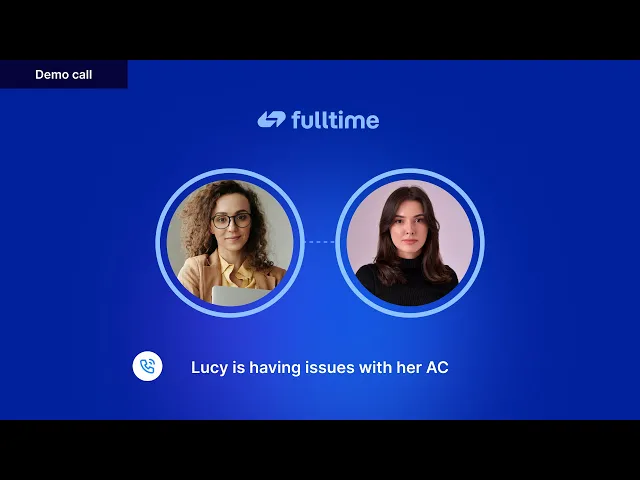
As the demo explains, instead of relying on staffed phone lines, the answering service answers incoming calls instantly with conversational AI that lets callers explain their reason for calling in their own words.
Rather than navigating phone trees or rigid menus, callers speak naturally.
The system automatically identifies intent, such as booking, rescheduling, cancelling, requesting information, or leaving a message, and moves the conversation toward a defined outcome.
Along the way, it captures relevant details and can update connected systems like calendars or CRMs based on predefined rules.
AI answering services are designed with clear boundaries.
When a call involves urgency, sensitive topics, or requests outside configured parameters, the system escalates the call to a human team member with context already collected. This preserves human judgment where it matters, without forcing callers to start over.
In this model, AI doesn’t replace internal teams or external agents.
The AI can serve as a support layer, absorbing call volume, reducing repetition, and filling coverage gaps. By handling routine interactions consistently and immediately, it reduces pressure on staff and allows human time to be spent on exceptions, complex cases, and in-person work that genuinely requires attention.
Key Differences Between AI Answering Services And Traditional Call Centers
As you can likely guess, the difference between the two systems becomes most apparent when demand spikes, when staff are stretched thin, or when calls fall outside the “ideal” script.
Call Availability & Response Time
Traditional call centers are constrained by staffing.
Calls are answered based on how many agents are scheduled, how long the queues become, and whether coverage exists at that moment. During busy periods, evenings, or weekends, callers may wait on hold or be routed to voicemail if no agents are available.
A Zoom study found that nearly 80% of customers expect short wait times when reaching customer support; however, they only experience short wait times around 60% of the time.
AI answering services directly address this issue.
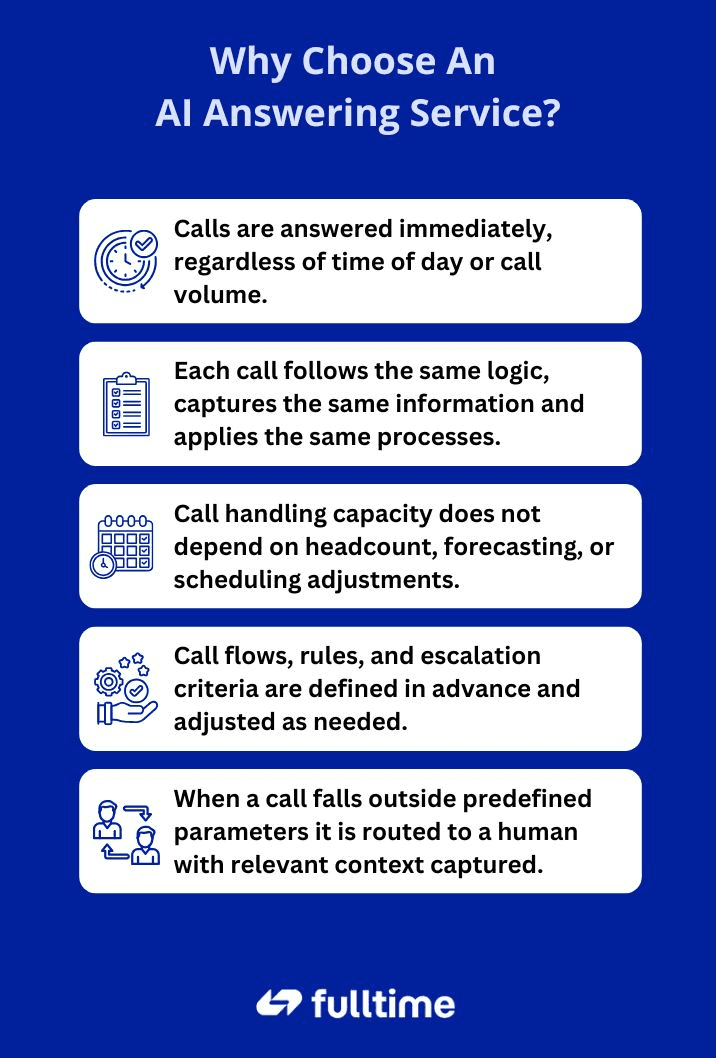
Calls are answered immediately, regardless of time of day or call volume. There are no queues to manage and no degradation in response time as demand increases. Coverage remains the same during business hours, after hours, and during sudden spikes in activity.
Consistency of Call Handling
Call centers depend on human agents following scripts and procedures.
While this allows for judgment and flexibility, it also introduces variation. Tone, accuracy, and how information is captured can differ from agent to agent, and performance can be affected by training quality, turnover, or fatigue over the course of a shift. This has led to customer critical error accuracy as the top QA metric that call centers track, with research from COPC reporting that 74% of businesses track this metric.
AI answering services operate within defined rules and knowledge boundaries.
Each call follows the same logic, captures the same information, and applies the same processes. When workflows or responses change, updates are applied system-wide rather than filtered through retraining cycles.
Handling Call Volume & Scaling
Scaling a call center is a staffing exercise. As call volume grows, businesses must hire, train, and schedule additional agents to maintain service levels.
Unexpected surges, everything from seasonal demand to marketing campaigns, or service outages, can overwhelm capacity even when overflow support is in place.
AI answering services scale automatically.
Whether a single call comes in or hundreds arrive simultaneously, each caller is answered immediately.
Capacity does not depend on headcount, forecasting, or last-minute scheduling adjustments.
Training & Setup Requirements
Maintaining a call center requires continuous investment in onboarding, training, quality assurance, and supervision. Even small changes to scripts or processes often require retraining agents and ongoing monitoring of adherence.
AI answering services shift this effort upstream.
Instead of training people, businesses configure systems. Call flows, rules, and escalation criteria are defined in advance and adjusted as needed, allowing changes to be implemented quickly and consistently without retraining cycles. McKinsey even reports that integrating AI with internal systems can reduce call volume by around 20%.
Escalation & Edge Cases
In traditional call center environments, escalation typically means transferring calls between agents or routing them back to internal teams. These handoffs often require callers to repeat information, increasing friction and the chance of drop-off.
As you saw above, AI answering services are built with explicit escalation thresholds.
When a call falls outside predefined parameters (due to urgency, sensitivity, or complexity), it is routed to a human who already has the relevant context captured.
The goal is not to reserve human intervention for situations that require judgment.
How Costs Scale in AI Answering Services vs Call Centers
The operational differences between these two models don’t stop at how calls are answered.
They also shape how costs behave over time.
Call centers tie expenses to staffing, schedules, and coverage decisions, while AI answering services shift costs toward systems and configuration.
For call centers, pricing is typically tied to agent time, call minutes, or per-seat fees. These are often bundled into monthly plans with overage charges. The average cost of a call center ranges from $8 to $15 per hour for offshore services to $28 to $40+ for domestic services.
While per-minute costs for shared services might be $0.35-$0.90, complex technical support can exceed $50 per call.
As call volume increases, costs rise in parallel. Extended coverage, such as evenings, weekends, or holidays, usually comes at a premium, and unexpected spikes in demand can require emergency staffing or overflow support.
There are also indirect costs that rarely appear on invoices.
Recruiting, onboarding, training, quality assurance, and management oversight all add to the total cost of operating a call center. Turnover can magnify these expenses, especially in high-volume environments where consistency and coverage are difficult to maintain.
AI answering services follow a different pricing model. Costs are generally usage-based or flat, tied to call volume or system features rather than staffed hours.
Because the system is not constrained by shifts or headcount, costs tend to remain predictable even when call volume fluctuates. Sudden surges in calls do not require additional staffing or short-term adjustments.
Overhead shifts as well. Instead of ongoing labor management, AI answering services concentrate costs around initial configuration and periodic updates to workflows or escalation rules. Changes that would require retraining in a call center environment are applied system-wide, reducing both time and administrative burden.
For many businesses, the decision comes down to how they want costs to behave. Call centers convert demand into variable labor expenses, while AI answering services treat call handling as an operational system with more stable, forecastable costs.
According to Boston Consulting Group, AI answering services even have the potential to drive 60%+ productivity gains, 10 to 20% short-term P&L improvements, and customer lifetime value increases of up to 30%.
The difference affects how organizations plan, scale, and respond to uncertainty.
When Each Option Makes Sense
AI answering services and traditional call centers solve different problems, which is why most businesses evaluate them based on use case rather than features alone.
Call centers tend to make sense when conversations are long, nuanced, or emotionally complex.
Situations that involve persuasion, negotiation, or deep subject-matter knowledge benefit from human agents who can adapt in real time. Businesses built around relationship-driven sales, account management, or high-touch support often rely on dedicated agents to handle calls from start to finish.
But many home service businesses face a different challenge.
Dispatchers, office managers, and receptionists often juggle phones, scheduling, paperwork, and in-person interactions simultaneously. When call volume increases, the traditional response is to add a call center to absorb the overflow.
AI answering services take a different approach. Instead of replacing staff or outsourcing conversations, they reduce the volume of calls that require human attention in the first place.
Routine requests such as booking, rescheduling, basic questions, and message intake are handled immediately and consistently, allowing existing staff to focus on the calls and tasks that actually require judgment.
Thinking back to the advantages of AI answering services, in this model, AI functions less like a call center replacement and more like a force multiplier.
Rather than scaling by adding external agents, businesses increase the effective capacity of the team they already have. Calls are answered, demand is captured, and staff spend less time reacting to interruptions and more time handling exceptions, follow-ups, and situations that genuinely require a human touch.
As researchers at Stanford’s AI lab have noted, “identifying the best ways for AI and humans to work together to achieve collective intelligence will become increasingly important.”
For many HVAC, plumbing, and electrical businesses, the decision isn’t whether to choose AI or a call center. The decision is around whether to keep adding layers of staffing or to make the people already on the team more effective.
Rethinking How Phone Coverage Scales With AI
If you want to see how AI answering works in practice for home service businesses, you can book a demo with Fulltime and walk through how calls are answered, routed, and escalated within your existing workflow, without adding a call center or replacing your team.
For more information: Book a demo
