
What Is an AI Answering Service? A Complete Guide for Home Service Companies

It's 7:30 PM on a Tuesday. You're finally sitting down to dinner with your family when your phone rings. You let it go to voicemail, thinking you'll call them back in ten minutes.
But by the time you pick up the phone to return the call, it's too late. They've already hired the competitor who answered on the first ring.
This scenario plays out every day for home service businesses, and missed calls are one of the most common ways to lose work.
In fact, 85% of customers do not follow up if their first call goes unanswered. However we know that between field technicians, after-hours emergencies, and seasonal call spikes, it's not realistic for most HVAC, plumbing, or electrical companies to answer every call live.
Traditional solutions like voicemail, call routing, or outsourced call centers often fall short.
AI answering services are designed to solve this specific problem.
They answer calls instantly, understand why a customer is calling, collect key job details, and route or book work based on your business rules.
This guide explains what an AI answering service is, how it works, where it fits alongside your team, and when it makes sense for a home service business. But to understand why this technology is a leap forward from the old ways of doing things, we first need to define exactly what it looks like in practice.
What Is an AI Answering Service?
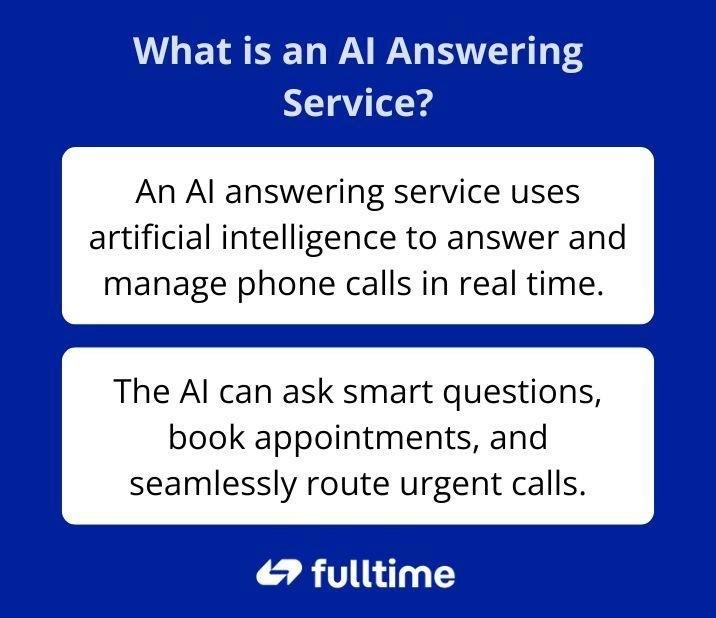
An AI answering service is a phone system that uses artificial intelligence to handle incoming calls in real time. Instead of forcing callers through automated menus or sending them to voicemail, it listens to natural speech, understands intent, and responds conversationally.
The AI can ask clarifying questions, assess the caller's needs, and determine the appropriate next step without breaking the flow of the conversation.
For home service companies, an AI phone answering service works as a reliable first-line assistant available 24/7.
This means routine calls are screened and qualified, urgent issues like "no heat" or "leaking pipe" can be escalated immediately, and appointments can be booked or routed to the right technician.
When no immediate action is needed, the system captures detailed notes for follow-up. The result is simple: every call is answered, leads aren't missed, and your team stays focused on the work that actually requires a human touch.
The entire experience may feel seamless to the caller, but there's a structured system working behind the scenes.
How Does an AI Answering Service Work? (Step by Step)
To understand how an AI answering service works in practice, think of it as a virtual front-office coordinator.
Typically, an AI answering service will use the following logic:
1. The AI identifies the caller's intent
As the caller explains their situation, the AI listens for cues that indicate whether the call is about a new service request, an urgent issue, scheduling, or a follow-up.
This allows the conversation to move in the right direction immediately, without forcing the caller to navigate menus or endure repetitive prompts.
2. Qualifying questions are asked
After the intent is clear, the AI asks relevant follow-up questions.
These questions adapt based on the caller's answers and are designed to collect the same information an experienced dispatcher or office coordinator would need before scheduling or dispatching a job.
3. The call is handled according to your business rules
Throughout the call, the AI keeps the interaction focused and professional.
The tone remains steady and clear, which helps reassure callers while keeping the conversation efficient, even during urgent or stressful situations.
4. The AI captures and confirms key details
Once the issue is understood, the AI confirms the caller's contact information and service address.
Names, phone numbers, and location details are verified before the call ends, reducing the need for follow-up and minimizing errors that slow down operations.
5. The AI initiates next steps
With the necessary information collected, the AI moves into scheduling or handoff.
Depending on how the business is set up, it may book an appointment directly or create a request for the team to review and confirm. A structured call summary is then sent to your office staff, so nothing is lost.
6. The call is closed professionally
Before ending the call, the AI confirms what will happen next. This ensures the customer knows their request is in progress and leaves the interaction feeling organized and professional.
Here's an example of how Fulltime's AI answering service works in the real world.
With a clear view of how AI handles calls from start to finish, you can see that these AI tools can act as an extension of your office.
But if you've already invested in a traditional solution, you might be wondering how this actually stacks up against the status quo.
The reality is that while traditional methods worked for years, they often create "friction" just when your business is busiest.
Why Choose an AI Answering Service vs Traditional Options?
The difference comes down to how well traditional options perform when call volume increases, staff are unavailable, or customers need fast answers.
Here is how AI answering services compare to the three most common ways home service companies handle their phones today.
AI Answering Service vs Voicemail
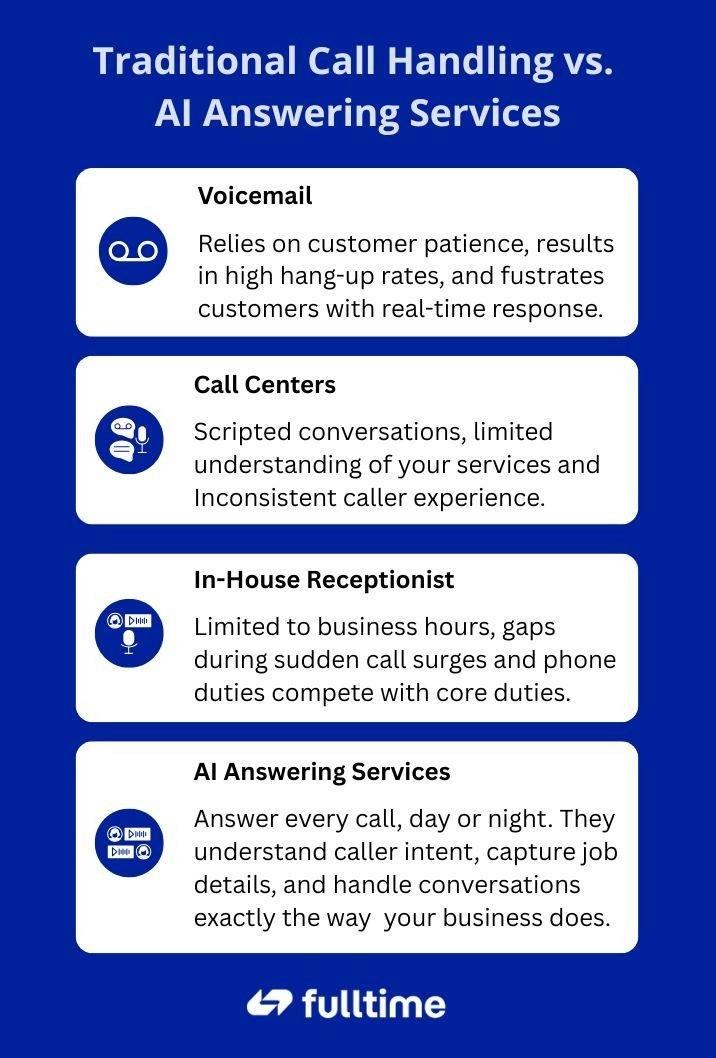
Voicemail is still one of the most common call-handling methods in home services, but it relies entirely on the customer's patience. As we mentioned earlier, when a homeowner calls with an urgent issue and hears a voicemail greeting, many simply hang up and call the next company. By the time the business returns the call, the job is often already gone. To make matters worse, many younger customers avoid phone calls altogether, so even returned calls may go unanswered.
An AI answering service removes that friction.
Instead of asking callers to leave a message and wait, it engages them immediately, collects the details of the issue, and ensures the request is captured and routed correctly.
AI Answering Service vs Call Centers
Call centers offer live coverage, but they often come with trade-offs.
Agents typically follow fixed scripts, may not understand the nuances of your services, and rotate frequently. This can lead to inconsistent call handling and generic conversations that don't reflect how your business actually operates.
AI answering services are consistent by design. They follow your business rules, use your terminology, and handle calls the same way every time.
They're also available around the clock without added staffing costs, making them easier to scale during peak seasons without sacrificing response quality.
AI Answering Service vs In-House Receptionists
Your office staff is your greatest asset.
In-house receptionists provide a personal touch, but coverage is limited to business hours.
Lunch breaks, sick days, after-hours calls, and sudden call spikes all create gaps where calls go unanswered or are rushed.
An AI answering service fills those gaps.
Remember, AI answering services are not designed to replace your office staff.
Instead, they're designed to support them by handling overflow calls, after-hours inquiries, and routine requests.
This allows receptionists and dispatchers to focus on coordination, customer follow-ups, and higher-value tasks rather than being constantly interrupted by calls.
What It Can't Do (And Why Human Staff Still Matter)
AI answering services are designed to manage the front end of a customer interaction.
AI answering services are not designed to replace human judgment.
Understanding where the handoff should happen helps set the right expectations and ensures the technology is used effectively.
Complex troubleshooting still needs human expertise
An AI can gather symptoms, context, and basic details, but diagnosing nuanced issues or walking a homeowner through detailed fixes is best handled by experienced technicians or support staff.
That's why the AI routes complex calls back to your office staff.
Sensitive or emotional conversations benefit from a human touch
Calls involving complaints, disputes, or frustration often require empathy, judgment, and flexibility that go beyond structured call handling. AI answering agents are built to recognize the tone and situation and transfer the interaction to a human who can respond with empathy and judgment.
High-touch sales still require people
For larger projects, detailed quotes, or consultative sales discussions, the AI gathers preliminary details and then connects the caller with a team member who can guide the conversation forward.
Why a hybrid approach works best
For most home service companies, the most effective setup is a hybrid one.
The AI answers calls, qualifies requests, and routes work efficiently, while your team steps in when human expertise or personal interaction is needed.
Used this way, AI acts as a first-line assistant, supporting your staff and ensuring every call reaches the right place at the right time.
This balance is driven by a specific set of features that guide how each call is handled.
Key Features to Look For in an AI Answering Service
Not all AI answering services are built the same.
For home service companies, the most important differences come down to how well the system fits real call scenarios and supports day-to-day operations.
1. A natural-sounding voice and flow
Robotic voices can frustrate customers who are already stressed about a home emergency. A recent study found that nearly 7 in 10 consumers believe that more natural-sounding AI via phone would enhance their experience.
Callers should feel like they're speaking with a front-office assistant rather than navigating an automated system, especially during urgent or stressful situations.
The AI should be able to handle interruptions, say "um" or "got it" naturally, and maintain a professional, calm tone that puts the caller at ease.
2. Industry-specific workflows
A general-purpose AI won't know the difference between a "heat pump" and a "furnace," or a "main line clog" and a "leaky faucet."
Your service should come pre-trained on industry terminology so it can ask the right qualifying questions without you having to build the logic from scratch.
3. Intelligent emergency call handling logic
Beyond understanding what the caller is talking about, the AI must know what to do next.
An effective system applies predefined priority rules to determine when a call requires immediate escalation, special handling, or rapid routing. Emergency situations and high-value opportunities are flagged and handled differently from routine service requests, ensuring critical calls don't get lost in the queue.
4. CRM and scheduling integrations
If the AI doesn't talk to your software, it's just creating more work for your office.
Call information should flow directly into your existing systems, so look for integrations with popular home service CRM tools.
Integrations reduce manual work, limit errors, and make it easier for your team to act quickly on new requests.
5. Clear call summaries and transcripts
After each call, your team should receive a structured summary outlining the customer's issue, contact details, and any scheduling preferences.
This makes follow-up faster and more reliable.
You shouldn't have to listen to a 3-minute recording to find a phone number. The system should provide a concise, text-based summary delivered via SMS or email immediately after the call ends.
6. Custom business rules
Every company operates differently.
The ability to configure hours, service areas, priorities, and call-routing rules ensures the AI supports your workflow instead of forcing changes.
When an AI Answering Service Makes Sense for Your Business
AI is everywhere right now, and it's easy to feel like you're falling behind if you're not using it.
In reality, an AI answering service isn't necessary for every home service company. But there are clear situations where it becomes especially valuable.
1. You Are Spending Heavily on Marketing
If you're investing significantly in marketing, every missed call is a direct loss of marketing dollars.
AI makes the most sense when your "speed-to-lead" is the deciding factor in whether you win a job. Since the AI answers on the first ring, you ensure that the leads you paid for don't end up calling the next contractor on the list.
2. You Have Significant "After-Hours" or Weekend Volume
Many homeowners don't discover a burst pipe or a broken AC until 6:00 PM or on a Saturday morning.
If your current solution for these hours is a "we'll call you back Monday" voicemail, you are leaving money on the table.
AI is ideal for businesses that want to capture and qualify these high-intent leads 24/7 without paying for an expensive overnight shift.
3. Your Office Staff is Tied Up With Routine FAQs
If your skilled dispatchers or office managers spend 40% of their day answering the same questions:
"What are your hours?"
"Do you service my area?"
"When is your next availability?
Then it's time for AI.
For example, Fulltime is designed to handle these repetitive "front-line" inquiries, freeing up your human team to focus on complex dispatching and high-value customer relationships.
4. You Experience Sharp Seasonal Spikes
In the trades, call volume can feel like a series of mountains rather than a flat line. During a summer heatwave or a winter freeze, your call volume can triple overnight.
AI makes sense because it is infinitely scalable. AI phone answering services can handle 10 or 100 calls simultaneously, ensuring that no customer hears a busy signal even during your busiest week of the year.
5. You Serve a Bilingual Customer Base
For companies operating in regions with diverse populations, such as those requiring both English and French support, hiring bilingual staff can be difficult and expensive.
An AI service like Fulltime provides bilingual coverage from day one, allowing you to professionally serve a wider market.
Of course, there are many additional business reasons why an AI phone answering service makes sense, but these are among the most common.
For businesses hitting these pressure points, an AI answering service often becomes less of an experiment and more of a practical next step.
AI Answering Services Are Designed to Support Your Team, Not Replace It
When used properly, AI becomes an extension of your office.
Your staff still handles judgment calls, complex troubleshooting, sales conversations, and customer relationships.
The AI simply ensures those interactions start on a solid footing instead of from a missed call or incomplete voicemail.
By ensuring that every call is answered on the first ring, no matter the time of day or seasonal volume, you stop the "leak" in your sales funnel.
For businesses facing these pressure points, AI is the most efficient way to capture every lead, qualify every emergency, and ensure your marketing dollars are never wasted on callers who move on to the next competitor.
For more information: Book a demo